Birding Trip to Beltzville State Park

Beltzville Lake is one of the premier locations for waterfowl in our area, and Winter is a great time for a wide variety of ducks and other waterfowl.

Saturday, Jan 24 · 8:00 AM to 11:00 AM EST

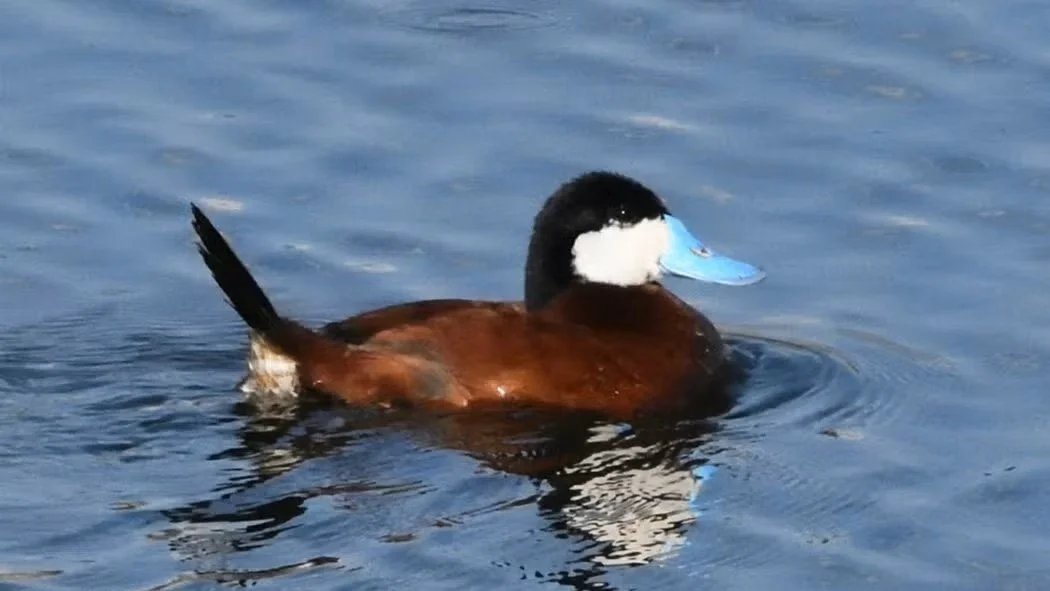
Photo of a male Ruddy Duck by Dave DeReamus

We'll scan the lake from a few vantage points for waterfowl, while keeping an eye on the nearby fields and forests for other birds. A scope is not needed, but if you have one please bring it along.

Where:  Beltzville State Park, 2950 Pohopoco Dr · Lehighton, PA

Meet at: Beltzville State Park, Parking Lot A for Pavilion #4, located at 40.861464, -75.624825

Leader: Rob Bergstresser (570-657-0990); For questions, please contact Rob

LVAS Meetup:  https://www.meetup.com/lehigh-valley-audubon-society/events/312541838/?eventOrigin=group_upcoming_events

Location via Google Maps: https://www.google.com/maps/place/40%C2%B051'41.1%22N+75%C2%B037'28.9%22W/@40.86142,-75.6247,17z/data=!3m1!4b1!4m4!3m3!8m2!3d40.86142!4d-75.6247?entry=ttu&g_ep=EgoyMDI2MDEwNy4wIKXMDSoASAFQAw%3D%3D

A Few Basic Field Trip Guidelines:

• Cell phones should be on silent or vibrate mode.

• Keep voices low while birding to minimize disturbance of the birds and allow others in the group to hear the birds and learn their songs.

• Keep pace with the trip leader. Please do not jump ahead or fall behind.

• Bring your binoculars.

• Beginners and experienced birders all welcome!

Have fun!

Never miss a guided walk or other LVAS event; become a member of our chapter!

Bird Watching Field Trip to Allentown Lakes

join lvas president, Barbara Malt, to check out some local lakes in Allentown for waterfowl and other birds.

Saturday, Jan 17 · 9:00 AM to 11:30 AM EST

These lakes are spring-fed and do not typically freeze, attracting a nice variety of waterfowl in the winter. We will begin at Trexler Memorial Park, and then will drive to a couple other local lakes.

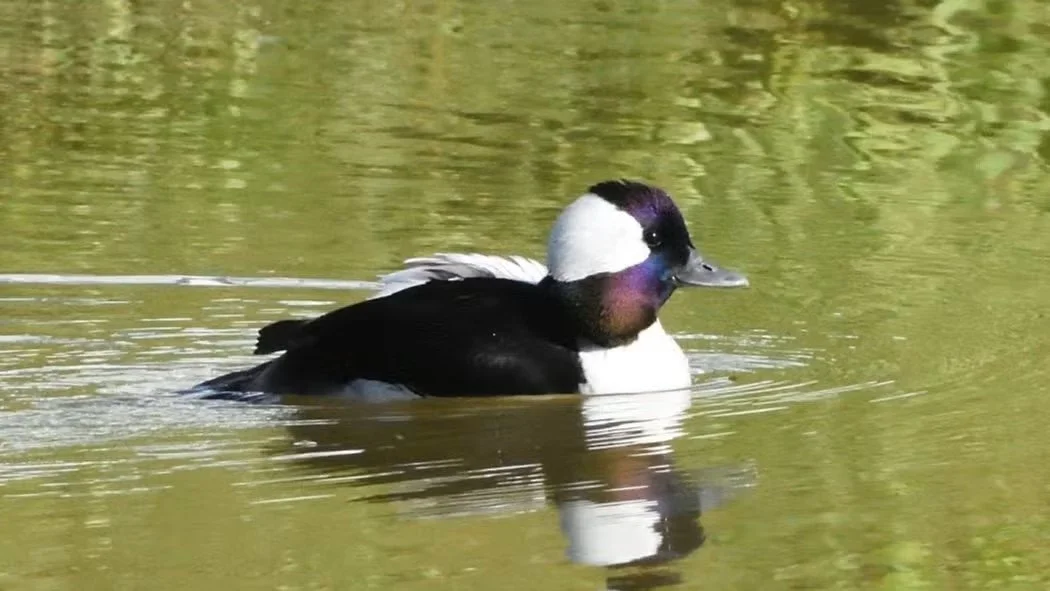
Bufflehead photo by Dave DeReamus

Meet at the Trexler Memorial Park parking lot off Springhouse Road (40.590167, -75.529470)
Leader: Barbara Malt (610-657-2582)

Never miss a guided walk or other LVAS event; become a member of our chapter!

Winter Ducks of Pennsylvania Presentation

learn about wintering ducks.

Friday, Jan 16 · 7:00 PM to 8:30 PM EST

For those that missed this LVAS Zoom program on January 16 or those who wish to see it again, use this link to access the program recording: https://www.youtube.com/watch?v=gefMHzu2iDc

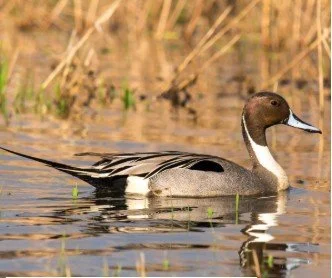
Photo of Northern Pintail Photo credit Mick Thompson

Northern Pintail Photo credit: Mick Thompson

This talk will provide an overview of dabbling and diving ducks that can be seen in winter in the Lehigh Valley. We will discuss the variety of ducks found here, their habits and habitats, why they are here, and how they survive Pennsylvania winters.

Perfect for beginning and intermediate birders who would like to get to know the wintering ducks.
We hope you can join us.

Never miss a presentation or other LVAS event; become a member of our chapter!

Registration Open Now for CBC4Kids on January 10th

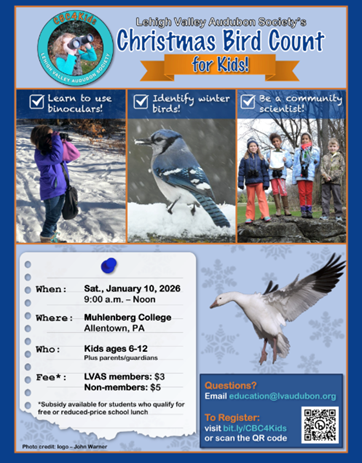
2026 CBC4Kids Event Flyer

Sat, Jan 10, 2026 · 9:00 AM to 12:00 PM EST

To register for the event, please visit this link:
https://www.lvaudubon.org/shop/cbc4kids

Join the Lehigh Valley Audubon Society for our annual Christmas Bird Count for Kids (CBC4Kids), a fun introduction to birding and community science that teaches kids how to use binoculars, identify common birds, and collect scientific data.

The CBC4Kids is based on the National Audubon Society’s Christmas Bird Count, a 125-year-old citizen science event that has become a cherished holiday tradition for birders nationwide.

Following a short, fun, interactive session learning about birds, citizen science, and how to use binoculars, CBC4Kids participants will form teams and (under the guidance of LVAS members) conduct a bird count in a nearby park. After an hour of birding, everyone will reconvene to tally up the data and share their discoveries.

All children must be accompanied by a parent or guardian.

$3.00 per child for Lehigh Valley Audubon Society members and $5 per child for non-members. Subsidy available for students who qualify for free or reduced price lunches.
To register for the event, please visit this link:
https://www.lvaudubon.org/shop/cbc4kids

Please contact education@lvaudubon.org if you have any questions.

We will start in a classroom at Muhlenberg College and then move to a nearby park for the count. Location details will be sent to registered families.

Lehigh Valley Christmas Bird Count 2025

Brandon Swayser

This year will mark the 126th annual Audubon Christmas Bird Count (CBC), the world’s longest-running citizen science project and wildlife census.

The Lehigh Valley Christmas Bird Count will take place on Saturday, December 20, 2025. This will be the 82nd year of our count.

The Lehigh Valley Audubon Society (LVAS) administers the annual Lehigh Valley Christmas Bird Count, and several other counts occur nearby, any of which could use your help!

We are looking for 2 types of volunteer participants in our designated circle, feeder-watchers and extra counters.

Feeder-watchers who live within this circle are needed to accurately identify all species commonly seen in their yard.  They count birds for any length of time on the 20th and report your sightings on a datasheet that we will provide.

Extra counters will be placed on one of our 12 area leaders' teams, within our designated circle, to drive/walk most of the day to count birds.

We hope you can join us!

If you have any questions, please feel free to contact LVAS’s count complier Brandon Swayser at brandon.swayser@davincisciencecenter.org

What is the Christmas Bird Count?

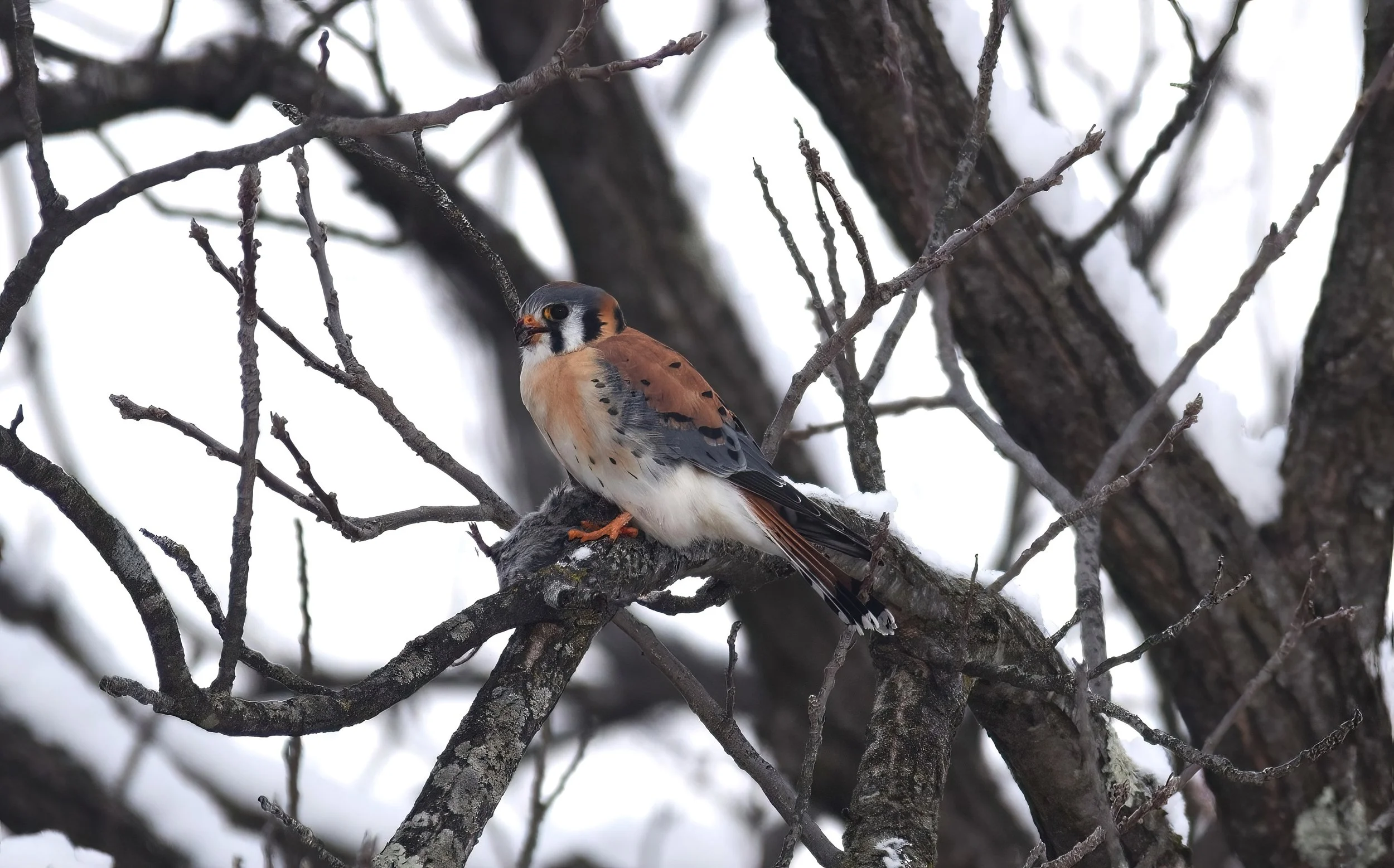
American Kestrel photographed during the 2024 Lehigh Valley CBC

American Kestrel photographed during the 2024 Lehigh Valley CBC

For those of you who are unfamiliar, the CBC is an annual volunteer-run census of birds that takes place across the western hemisphere from December 14th through January 5th every year. It is made up of thousands of local counts, each lasting 24 hours, covering a 15-mile wide diameter circle of land, and organized by a count compiler. Teams of volunteer counters typically split up areas of the circle and drive and/or walk those areas for up to 24 hours straight, recording the birds that they observe. Christmas Bird Counts are rich in tradition and camaraderie, and due to their thorough nature, often turn up some pretty incredible birds! For many birders, the CBC is one of the highlights of their year, a chance to catch up with old friends, see some rare birds, and above all else, contribute meaningful data to one of the worlds’ most powerful conservation science studies.  

That sounds great and all, but isn’t really my cup of tea, how else can I help?

It’s understandable that spending 12+ hours straight birding in the cold isn’t for everyone, but there is another way in which most people can participate, and that is by being a feeder-watcher. Feeder-watchers spend a portion of their area’s count day observing their backyard birdfeeders, or any birds in their yard or local greenspace, and report their sightings to their area’s compiler.


Here are a few easy steps for getting involved as a feeder-watcher: 

  1. Determine which (if any) circle your backyard is in by going to:  https://www.audubon.org/community-science/christmas-bird-count/join-christmas-bird-count. Click the bold link on that page that says “click here for a map view of circles expected…” and zoom in to your home area on the map. If you are in a circle on that map, click the yellow bird icon in that circle and you will see the count date, and compiler’s contact info. This map may not be updated until November.

  2. Contact the compiler to see if you can sign up to be a feeder-watcher for that count. Don’t wait until the last minute. 

  3. On the day of the count, keep a checklist of all bird species you see at your feeders, recording only the highest number of each species that you saw at one time - birds will often visit feeders many times over the course of the day, so this part is important. You also must record your effort - the amount of time that you spent counting birds in your yard and the number of observers who counted with you.

  4. Finally, follow your compiler’s instructions (usually a simple email) for reporting your observations. 

Why is the CBC important?

By conducting a standardized survey of birds on the same date, in the same location, with the same methods, and usually by the same people year after year, we gain incredibly valuable data on long term changes in bird populations. CBC data has been the first alert to many population trends over the years and has made an immense impact on avian conservation science. Count data has pointed out downward population trends like that of Evening Grosbeaks and Common Grackle and has helped to inform scientists and catalyze the next steps of conservation work to help these species. Additionally, the CBC is a great way to get new birders involved and grow our team of citizen scientists, and hey, it’s fun!
Former LVAS President, Dale Steventon, Shares History & Video of Bart Snyder's Egg Collection

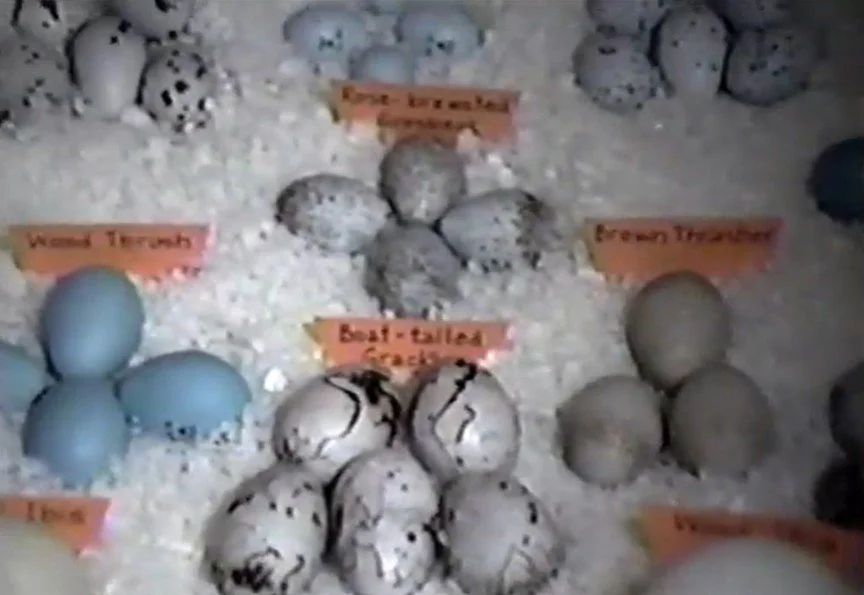
Preview Video Clip of Bart Snyder's Egg Collection, courtesy of Dale and Alison Steventon

In mid-October, 2025, LVAS President, Barbara Malt, received an email from Dale Steventon saying “I am 90 years old. I was president of the Lehigh Valley Audubon Society in 1977 to 1980. I would like to share several things with you...” Barbara and LVAS History Committee Chair, Betty Abrams, met with Dale and his wife, Alison, in their home in Schnecksville on November 10th.

During their visit, Dale kindly shared an hour-long video that he and Alison recorded in 1993 while visiting Bart Snyder’s museum of wildlife specimens. Snyder (1906-1998) was a member of LVAS and an amateur ornithologist and oologist – a person who studies or collects bird eggs. His personal museum, the largest private collection of its kind in North America, included mounted birds and more than 16,000 eggs representing more than 500 different species. Most specimens included valuable scientific data, including when, where, and by whom they were collected.

A 1987 Morning Call article offers some background on Snyder and his unique collection: “Snyder began his unusual hobby at age 14 when his cousin gave him a set of eggs. Later he became acquainted with oologists all over the country and traded specimens, thereby enhancing his collection. Only about 20 percent of the inventory was collected by Snyder himself. He’s long maintained state and federal licenses necessary for collecting and keeping the specimens, which have been emptied of their contents and rest on beds of foam mulch in cabinets in Snyder’s basement. Although legal at one time, for many years it’s been against the law to take eggs from nests – a point that Snyder underscores each time he speaks to students.”

The contents of Snyder’s collection have since been donated to various research institutions and organizations, including Muhlenberg College. This is a preview of the full video, which offers a rare glimpse of Snyder’s full collection while it was still on display in his West Allentown home.

LVAS thanks Dale and Alison for documenting Snyder’s collection and sharing this video. To view the full-length video, check out Lehigh Valley Audubon Society’s YouTube channel or visit this link: https://www.youtube.com/watch?v=KCtMlOxdqYE